SRJC Forward
Paths to Completion for SRJC Students
Paths to Completion, sometimes known as program maps, show a clear, semester-by-semester path—built from faculty-approved sequences—for credit and noncredit certificates and degrees at the college, so students can plan and complete their educational goals according to their intent.
Design Principles
These are the shared design principles guiding how SRJC Forward reimagines programs, services, and systems—so the student experience is clearer, more supportive, and more connected across the college. The Paths to Completion initiative reflects these principles in its design and student-facing approach.
Each design principle is expressed as a short adjective label. These labels are cited across SRJC Forward pages to indicate which principles are being intentionally applied in a given project or initiative. See the full page: Design Principles
What are Paths to Completion?
Paths to Completion provide students with a clear, semester-by-semester sequence of courses and milestones that support completion of credit and noncredit certificates and degrees according to student intent—full-time or part-time. In this context, programs include majors and certificates.

A student-facing view of faculty-approved sequences
Paths rely on department-developed course sequences and enhance earlier efforts by placing those sequences in front of students in the context of exploring majors and certificates.

Supports planning and momentum
Paths can incorporate general education choices and key milestone tasks that support momentum, helping students prepare for comprehensive educational planning with educational counseling.
Program review and revisions
Programs should review and update their course sequences now
During this review stage, programs are asked to confirm or revise the course sequences that will appear in Paths to Completion. Each program should submit both a full-time sequence and a part-time sequence.
Revisions should be submitted on the Paths to Completion Revisions page by May 22. If a program does not submit an updated sequence by that date, SRJC will use the sequence currently on file.
After this review cycle, future updates will be made in the new curriculum software that will debut in the Fall 2026 semester.
Why use Paths to Completion?
Clarity
Students can see which courses to take each term to avoid taking unintended units.

Career connection
Students can see how courses connect to majors, certificates, and regional career opportunities.

Milestones and momentum
Paths highlight momentum points—such as completing transfer-level Math and English early—and other actions that support college success.

Timelines that match student intent
Paths support planning toward a student’s intent, helping students understand steps toward completion. Related: time to completion.
CourseLeaf + the new catalog

A single platform for curriculum, catalog, and student-facing information
Paths to Completion will be supported through CourseLeaf, launching alongside the college’s new catalog system. This shift supports a more integrated way to connect curriculum, catalog content, and student-facing program information.
At launch, paths will be generated using existing, approved course sequence information already on file or submitted through the review process. At this stage, Paths to Completion are designed to support student understanding and comprehensive educational planning with educational counseling. They do not determine course scheduling decisions.
Sample layout
Below is a sample of the kind of student-facing layout the college is moving toward, based on Citrus College’s ADT in Business Administration.
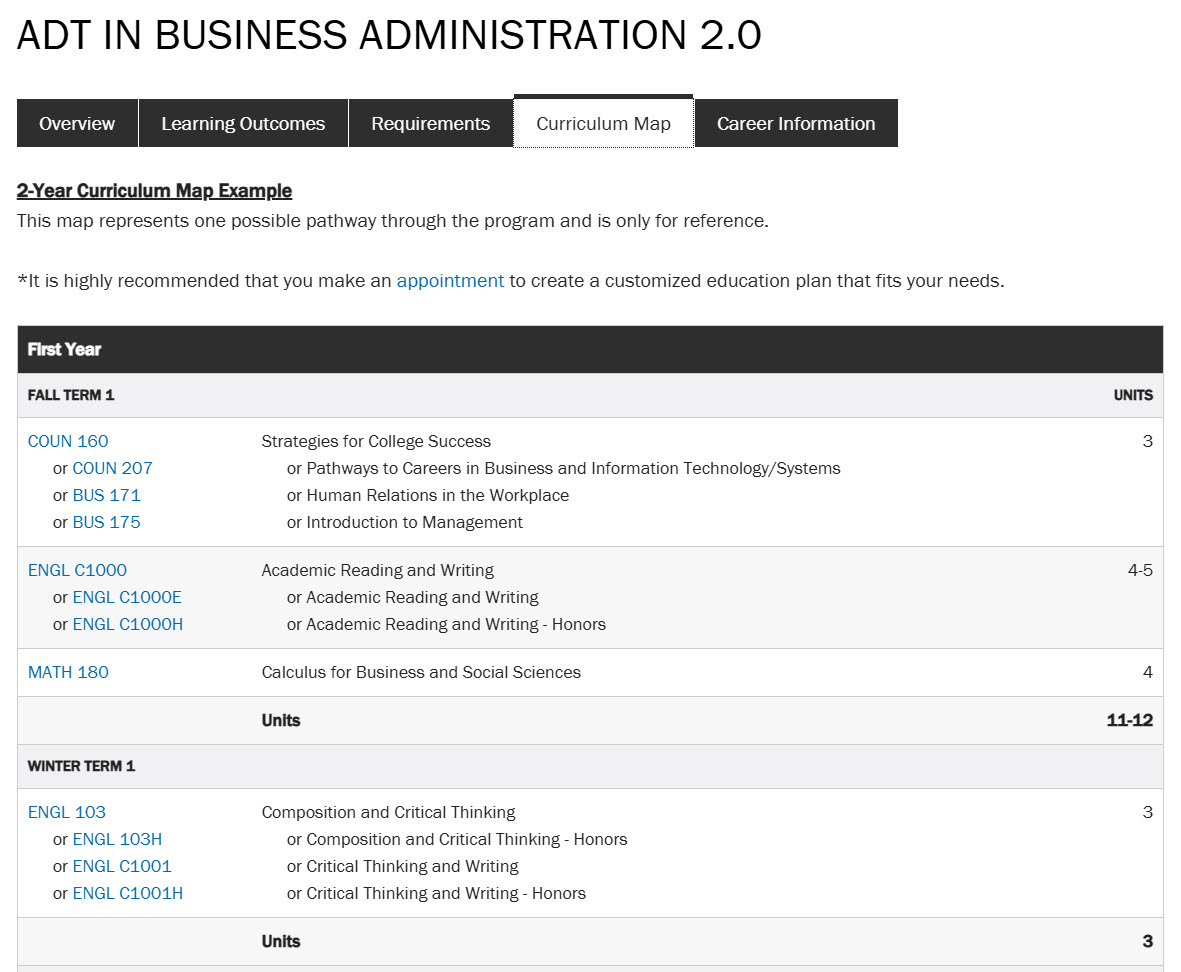
This sample is provided to illustrate the overall student-facing format and level of detail, not to represent a final SRJC layout or sequence.
Institutional alignment
Paths to Completion strengthen SRJC Forward by aligning with the plans and standards we already use to guide decisions and support students.
Mission
Supports student understanding and completion of certificates and degrees aligned with academic, career, and personal goals.
Strategic Plan
Advances priorities related to student completion, pathway clarity, and reduced barriers to progress.
Student Equity Plan
Improves transparency around expectations and milestones, helping reduce equity gaps in time to completion.
Strategic Enrollment Management
Provides consistent program-level information that supports educational planning and student persistence.
Accreditation Standards
Documents coherent programs, clear requirements, and intentional support for student learning and completion.
```